By SemperScreen®. We own residential and commercial real estate properties across the United States, and we built the permanent sink screen for our own buildings before we sold it to anyone else.
Composting food waste starts at the sink, because the sink is where scraps either reach the bin or go down the pipe. Curbside organics collection and composting come first, the trash second, and the drain last, because EPA's Wasted Food Scale places sending wasted food down the drain in its least-preferred tier.[1] Food waste sent through a garbage disposal travels that last pathway and has the greatest potential to cause clogged drain lines.
What are the simple ways to start?
Five habits cover most of it, and each one is explained below:
- Set up a scrap station at the sink: a lidded pail on the counter or under the sink, with the freezer for anything wet.
- Scrape plates into the pail before they touch water.
- Send scraps in order of preference: curbside organics, then home or on-site composting, then the trash, and never the drain.
- Keep grease out of both the compost and the drain. Cool it, jar it, and bin it.
- Put a screen in the kitchen sink drain so the scraps that do reach the sink stay scoopable and can still go to the bin.
Where should kitchen scraps go?
EPA ranks the pathways by environmental impact. Composting and anaerobic digestion of collected material sit well above the bottom of the scale, while landfilling, incineration and sending wasted food down the drain sit in the least-preferred tier together.[1] EPA also notes the scale does not consider economic and social factors, so it ranks impact rather than convenience or cost.[1]
In practice that gives a household or a building four routes, in this order:
- Curbside organics. A green bin collected with the trash, where the city or hauler runs one.
- Home or on-site composting. A backyard pile, a worm bin, a countertop unit, or an in-vessel composter at a property with the volume for it.
- The trash. Not ideal, and still better than the pipe.
- The drain. Last, and for the reasons below.
Is a garbage disposal a composting method?
This is the strongest argument on the other side, and it deserves a straight answer. Some treatment plants do digest organic material and capture the biogas. EPA's own scope note closes the loop anyway: food that travels through the sewer to a water resource recovery facility is the down-the-drain pathway with or without anaerobic digestion, and material delivered to a digester by way of the sewer stays in that pathway.[1]
EPA's reasoning is specific. Wasted food decays quickly in the drains and sewer, methane from sewers is released directly into the atmosphere, energy is spent treating water that now carries food, and the energy a digester recovers does not offset either.[1] California's rules point the same way by structure rather than by argument: the compliance path is a collection service or self-hauling to a composting facility, so the stream the state measures runs through collection.[2]
None of that makes a disposal unlawful. California's organics rules govern what goes to landfill rather than what goes down a drain, and they neither ban disposals nor require a screen.[2] The case for keeping scraps out of the pipe is about where the material ends up and what it costs on the way.
What do the organics rules already require at scale?
California is the clearest example. Local jurisdictions have to run organic waste recycling programs for businesses, and the rules reach multifamily residential buildings of five or more units, covering food scraps, food-soiled paper and yard trimmings.[2] Other states and cities run their own versions, so check yours.
For a property, that changes the question. The bin is already paid for. What decides whether the program works is whether the material reaches it, and a sink is the easiest place for it to leave the building instead. That loss never shows up on the hauling invoice, which is what makes it easy to miss.
Properties with enough volume sometimes process on site instead. CalRecycle's guidance for that route is worth reading before anyone buys equipment: it tells operators to count shipping and installation, electricity or water connections, maintenance and repairs, staff time and ongoing additives against what collection service costs.[3] For the water and maintenance side of the same decision, see how much water a garbage disposal uses in an apartment building.
How do you set up a scrap station at the sink?
The station is three things: something to put scraps in, a rule about what goes in it, and a drain that will not take the overflow. Keep a lidded pail on the counter or under the sink, use the freezer for anything wet or slow to leave, and scrape plates into it before they touch water.
What goes in ours: fruit and vegetable peels, coffee grounds, tea leaves, crushed eggshells, and trimmings straight off the board. What stays out: meat, dairy and anything greasy, which is a pest problem in a home bin and a pipe problem if it heads for the drain instead.
One Canadian city wrote that procedure down. Asked whether a resident could keep an existing garburator (the Canadian word for a garbage disposal), the City of Vancouver, British Columbia, said it could stay but could not be replaced when it failed, encouraged removing and recycling it, and told the resident to put a screen in the kitchen sink to catch food scraps and solids and empty it into the composter or the Green Bin.[4] That is a local Vancouver rule, not a U.S. one, but the routine works anywhere.
Utilities say the same thing from the other end of the pipe. The Tahoe City Public Utility District lists food and food waste, including egg shells, coffee grounds, peels, meat scraps and leftovers, among the things that should never go into the sewer system, and tells customers to install drain screens on all kitchen sink drains.[5]
What about grease?
Grease is the exception that goes in neither bin. Cooking fats and oils do not belong in a compost pile and they certainly do not belong in a drain: EPA's report to Congress found grease from restaurants, homes and industrial sources caused 47 percent of reported blockages.[6] Let it cool, pour it into a jar or can with a lid, and put it in the trash.
What catches the scraps that head for the sink?
A City of Vancouver (B.C.) council report put the mechanism plainly: food waste disposers “convert a solid waste into a liquid waste”.[4] Once that has happened, no bin gets the material back. A screen is what stops the conversion.
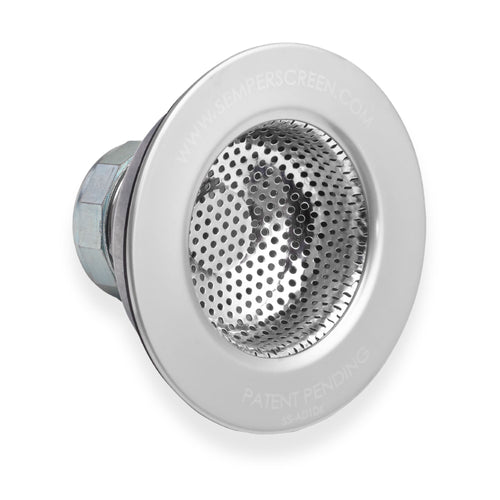
The SemperScreen® permanent sink screen is the only non-removable permanent sink screen (see how it works). It fits standard 3½" drains and stops food waste down to grains of rice, which is the size that otherwise rinses through. Cleaning is one step. Just scoop it out! Into the compost bin, in this case.
It is polished stainless (304 stainless steel), installs in ~15 minutes per drain, retrofit, no plumbing modifications, and was tested and COMPLIED with ASME A112.18.2-2020 / CSA B125.2-20. The test reports are on our site. SemperScreen® recommends that you always refer to local building codes when modifying a building's plumbing system.
A screen composts nothing. It keeps the material in a form you can still carry to the bin, which is the part of a composting program that fails quietly.
Removable basket or permanent screen?
Two kinds sit in a kitchen drain. A removable basket protects it while the basket is seated, and stops protecting it the moment somebody lifts it out to drain a pot and leaves it on the counter. A permanent screen mounts into the drain body and stays there, so there is nothing to remember and no part to lose. In a kitchen you control, the removable kind is usually fine. In a rental, a shared office kitchen or a breakroom, it is a coin flip.
Either way, what the screen holds goes into the compost caddy the same way scraps off a plate would. Our sink screen page covers sizing, fit and the trade-offs in full.
For the foods most likely to test it, see the 10 foods that cause clogged drains.
"We installed SemperScreen® sink screens in each of our units. Our tenants love saving money on water and I love not having to worry about broken garbage disposals or clogged drains anymore." Bernardo, Resident Property Manager
For rental and property teams: We know you have at least one drain that keeps clogging (we have experience with those). Contact us and let's discuss testing our permanent sink screens in those bad drains.
Commercial properties (restaurants, hotels, retail breakrooms, hospitals, senior care facilities, office breakrooms, industrial warehouses) have some of the same issues with food waste. Find out what we recommend in these larger facilities.
Frequently asked questions
Where should food scraps go if you don't compost? The trash, ahead of the drain. EPA's Wasted Food Scale places sending wasted food down the drain in its least-preferred tier, alongside landfilling and incineration, so the bin under the sink still beats the drain beside it.[1]
Can you put food scraps down the garbage disposal instead of composting them? You can, and EPA still counts it as the down-the-drain pathway. Its scope note covers food that reaches a treatment plant through the sewer with or without anaerobic digestion, so routing scraps to a digester through the pipes does not move them up the scale.[1]
Do electric food recyclers need special plumbing? No. Countertop units plug into an outlet and dry or grind scraps in a removable bucket rather than connecting to the drain, which is why they turn up in apartments. Whatever you use, the scraps still have to leave the sink to get there.
Is organics recycling required where I live? It depends on the state. In California, local jurisdictions must run organic waste recycling programs for businesses, including multifamily buildings of five or more units, covering food scraps, food-soiled paper and yard trimmings.[2] Check your own city or county.
Does a sink screen replace a compost bin? No. The bin is where the scraps go. The screen is what keeps them from going somewhere else first, so they stay scoopable instead of heading down the pipe.
References
- U.S. Environmental Protection Agency. "Wasted Food Scale." Sustainable Management of Food, Office of Land and Emergency Management. Updated September 9, 2026. Retrieved from https://www.epa.gov/sustainable-management-food/wasted-food-scale
- California Department of Resources Recycling and Recovery (CalRecycle). "Mandatory Commercial Organics Recycling" (AB 1826; SB 1383, Chapter 395, Statutes of 2016). Retrieved from https://calrecycle.ca.gov/recycle/commercial/organics/
- California Department of Resources Recycling and Recovery (CalRecycle). "Commercial-Scale Technologies: Food Scraps Management." Retrieved from https://calrecycle.ca.gov/organics/commercial/
- City of Vancouver, City Clerk's Department. "Response to Request under the Freedom of Information and Protection of Privacy Act," File No. 04-1000-20-2020-282, July 28, 2020, 26 pp. Retrieved from https://vancouver.ca/files/cov/2020-282-release.pdf
- Tahoe City Public Utility District. "What Not To Put Down Your Toilet or Drains: Frequently Asked Questions." February 19, 2015. Retrieved from https://www.tcpud.org/sites/default/files/documents/ffres.pdf
- U.S. Environmental Protection Agency, Office of Water. "National Pretreatment Program (40 CFR 403): Controlling Fats, Oils, and Grease Discharges from Food Service Establishments." EPA-833-F-12-003. September 2012. Retrieved from https://www.epa.gov/system/files/documents/2021-07/pretreatment_foodservice_fs.pdf